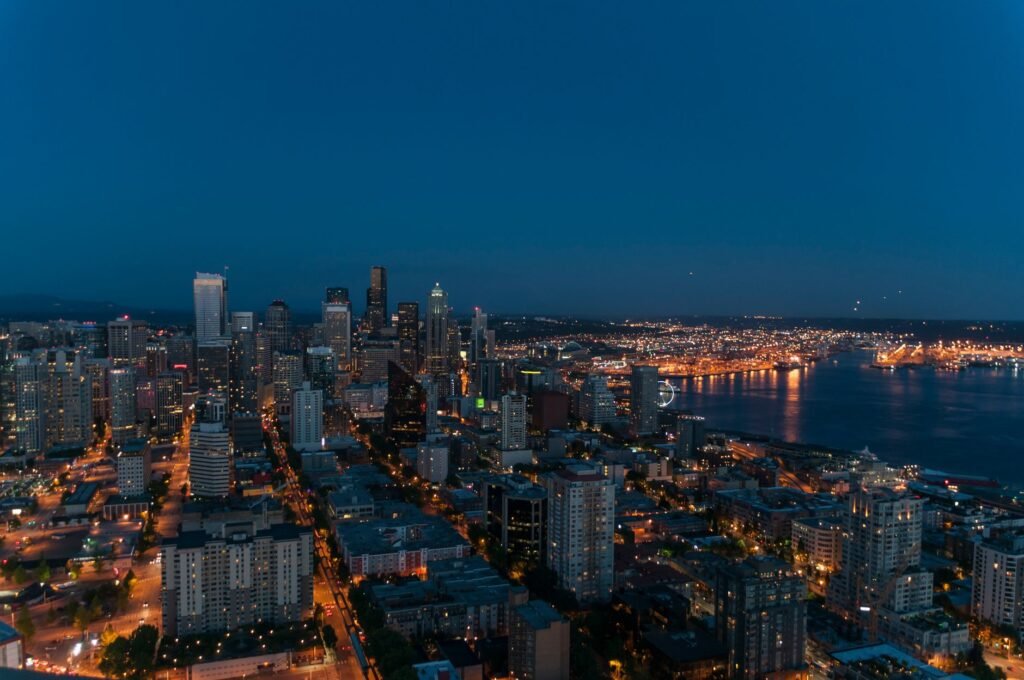
Seattle has a genuine supply of ghost stories, and most of them are attached to buildings you can still walk into. What follows separates the documented history — which is often stranger than the ghost story — from the legend built on top of it. Where a claim is folklore, it says so.
One correction worth making up front, because it appears in a lot of guides: the famous underground is in Pioneer Square, not under Pike Place Market. The two are about a mile apart.
The Seattle Underground, Pioneer Square
This is the real thing, and the history needs no embellishment. The Great Seattle Fire of 6 June 1889 destroyed most of the business district. When the city rebuilt, it raised the street level — largely to fix a sewer system that had been backing up at high tide. Ordinance 1836, passed in September 1891, established the new datum.
The streets went up by roughly 10 to 12 feet in most places — one storey — and close to 30 feet in a few spots where the original ground sat lowest. You will see “six or seven storeys” claimed elsewhere; it is wrong. What happened is that the new roadways were built at the height of the old second floors, leaving the original ground-floor storefronts and sidewalks sealed in a hollow space beneath. Those spaces are what you walk through on a tour.
The atmosphere does most of the work here. It is dark, damp, low-ceilinged, and the acoustics are strange — sound arrives from the wrong direction. Visitors report cold spots, footsteps and electronics draining. Whether that is paranormal or simply what a human brain does in a cold, dim, enclosed space with no clear sightlines is a question the tours leave open, which is to their credit.
Two companies run tours: Bill Speidel’s Underground Tour, operating since 1965 from the Pioneer Building, and Beneath the Streets, founded in 2013, which covers different sections and runs specialist routes. Both last around 75 to 90 minutes. Check current prices on their own sites and book ahead in summer. Wear shoes you do not mind getting dusty — the floors are uneven and genuinely dirty in places.
Reference: HistoryLink on the Pioneer Square regrade
The Butterworth Building and Kells, 1921 First Avenue
Probably the best-documented haunted building in the city, and the history is a matter of record. The Butterworth Building opened in October 1903 as the premises of Butterworth & Sons — Seattle’s first purpose-built mortuary. It had coffin showrooms, a funeral chapel, morgues, an embalming room and fireproof vaults for holding bodies. The firm outgrew it and moved in 1923.
Kells Irish Restaurant & Pub has occupied the basement and old stock room since 1983, and the staff there have been collecting stories for forty years: glasses moving, a girl in a white dress, figures in the mirror behind the bar. Local news has called it the most haunted bar in Seattle.
One claim deserves a caveat. You will frequently read that the basement held a crematorium. Contemporary accounts from 1904 describe the basement as housing the heating plant, stables and wagon storage. The crematorium detail may be a later addition to the story — it is widely repeated but not well evidenced.
This one is easy to visit: it is a working pub on First Avenue, a short walk from Pike Place Market. Go in, have a pint, ask the bartender. They will tell you.
Pike Place Market
The market opened in 1907 and has accumulated its own folklore, most of it attached to the lower levels — the warren of small shops below the main arcade, which are quiet and oddly lit in a way the busy upper floors are not.
The most frequently told story concerns Kikisoblu, known to settlers as Princess Angeline, the eldest daughter of Chief Si’ahl — the man Seattle is named after. She lived in a small waterfront cabin in the area and died in 1896, before the market was built. She is a real historical figure, and her grave is in Lake View Cemetery on Capitol Hill. Whether she walks the market’s lower floors is legend; that she lived and died nearby is not.
The lower levels are open during market hours and free to wander. Go on a weekday morning when it is quiet, which is also when the atmosphere is best.
The Paramount Theatre
The Paramount opened in 1928 at Ninth and Pine, a lavish piece of picture-palace architecture that survived the decades when most of its peers were demolished. It still operates as a performing arts venue.
The ghost story belongs to the staff rather than the public: a woman in period dress seen backstage and in the lower levels, doors and lights behaving oddly. These are anecdotes passed between employees over decades, not documented incidents, and the theatre does not market itself as haunted.
The honest reason to go is the building. Attend anything — a concert, a touring show, one of the silent film nights with the Wurlitzer organ. Tickets vary widely by event. The architecture alone justifies the evening.
Capitol Hill
A correction first: Capitol Hill is not Seattle’s oldest neighbourhood. That is Pioneer Square, where the city began in the 1850s. Capitol Hill was platted and developed largely in the early 1900s.
Its best-known haunted address was the Harvard Exit Theatre at 807 East Roy Street. The building was constructed in 1925 for the Woman’s Century Club, a suffragist organisation, and became a cinema in 1968. Staff reported a woman in early-twentieth-century clothing, furniture rearranged overnight, and the lobby fireplace lit before anyone arrived. The cinema closed in January 2015, so you can no longer see a film there — the building has since been redeveloped. You can look at it from the street.
Also on Capitol Hill is Lake View Cemetery, which is open to visitors and holds the graves of Seattle’s founding families, Kikisoblu, and Bruce and Brandon Lee. It is a working cemetery, not an attraction — visit quietly and during daylight.
Also read: Which Seattle neighbourhoods are safest
Georgetown Castle
A tall, strange Victorian house in Georgetown, south of downtown, built around 1902 and the subject of a long run of local ghost stories involving a woman at an upstairs window.
It is a private residence. Do not knock, do not go into the garden, and do not photograph through windows. If you are curious, look at it from the pavement as you pass and leave the residents alone.
Manresa Castle, Port Townsend
Worth correcting at length, because it is badly misplaced in many guides. Manresa Castle is at 651 Cleveland Street in Port Townsend, on the Olympic Peninsula — north-west of Seattle, not thirty miles south near Olympia.
Getting there takes roughly two to two and a half hours and involves a ferry: either Edmonds to Kingston, or Seattle to Bainbridge Island, then driving up the peninsula. Build the ferry wait into your plan.
The history is excellent. It was built in 1892 by Charles Eisenbeis, a Prussian immigrant who became Port Townsend’s first mayor, using brick from his own factory and timber from his own mill. The Catholic Archdiocese of Seattle bought it in 1927 as a residence for Jesuit priests, who named it after Manresa in Spain, where Ignatius Loyola founded their order. They added a wing with a chapel and thirty private rooms, stuccoed over the brick, and sold the place in 1968. It has been a hotel since.
The ghost stories centre on two rooms and involve a young woman and a Jesuit priest. Both tales have the shape of invented hotel folklore rather than documented history — the hotel itself has acknowledged as much over the years — but the building is genuinely atmospheric and the stay is a good one on its own merits. Rooms generally start around $130 and rise for the turret suites.
Reference: Pacific Coast Architecture Database
What to Expect, Honestly
Nothing dramatic. No one gets grabbed or pushed. What you get is old buildings with difficult histories, dim light, cold draughts and the particular feeling of standing somewhere that has outlived everyone who built it. Whether you read that as paranormal is your business.
Two practical notes. First, a few of these are private homes or working businesses — behave accordingly. Second, if you want the atmosphere without the crowds, the shoulder season works better than October, when every tour in the city is fully booked.
Historical dates and locations in this guide are sourced to HistoryLink, the Pacific Coast Architecture Database and public records, and were checked in October 2026. Ghost stories are identified as folklore where that is what they are. Prices and opening hours change — confirm before travelling. Found a mistake? Tell us on the contact page.